Tokenisati

Welcome to this week’s Tranched newsletter.
Tokenisation has spent the last two years proving itself in capital markets: bonds, funds, repo, sovereign debt. The infrastructure is real, the volumes are growing, and the institutional adoption is no longer speculative. But how can this technology extend its role into fixing some of the world’s biggest problems?
This week we take that question seriously. Water, carbon, and food are three of the world's most consequential resource systems, and all three are failing for the same structural reasons: broken measurement, illiquid rights, and fragmented coordination. Not coincidentally, those are precisely the problems that tokenisation and digital infrastructure are designed to solve.
We examine where the evidence supports that case, where it doesn't, and why the capital markets implications may be more significant than anyone is yet pricing in.
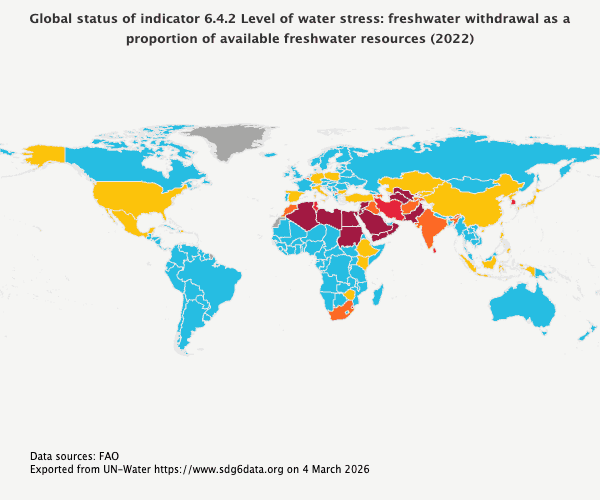
A January 2026 UN report declared the world had entered an era of "global water bankruptcy."
Water bankruptcy refers to a structural inability to repay the debt accumulated against natural water capital. Nearly three-quarters of the world's population now lives in countries classified as water-insecure or critically water-insecure, and an estimated 4B people face severe scarcity for at least one month per year.
But how do we address this problem and where is the connection with the world of digital assets?
A piece published this week on Blockzeit explored how tokenised water assets, which are digital representations of water rights, infrastructure, and usage entitlements, could begin to address this. The World Bank's Global Water Security and Sanitation Partnership facilitated $47.9B in water-related funding in 2025 alone, yet the supply-demand gap keeps widening.
The argument for tokenisation is that it moves capital more efficiently towards solving the problem.
That framing is worth taking seriously beyond water. It describes a structural role that digital infrastructure can play across a wider class of global challenges and wherever markets fail due to unreliable measurement, illiquid rights, fragmented coordination.
The Architecture of Market Failure
Three global problems share the architecture of market failure: water, carbon, and food. In each case, what's failing is the efficiency of information and institutional layer that governs its allocation.
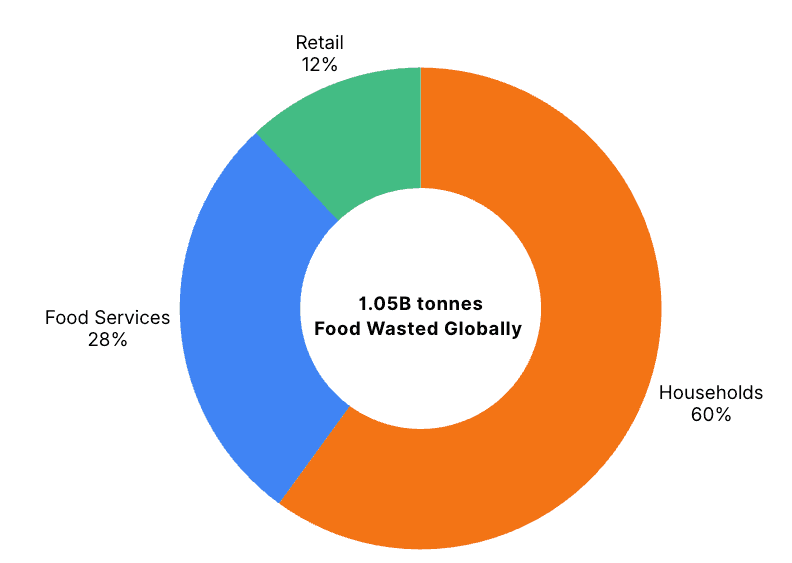
Agriculture accounts for roughly 70% of global freshwater withdrawals, yet pricing and allocation systems in most jurisdictions are opaque, politicised, and difficult to audit. Carbon markets have created a nominal price for emissions reductions, but the voluntary market, which peaked at over $2B in 2022, has been plagued by credibility failures that undermine the price signal entirely. And globally, 1.05B tonnes of food are lost or wasted annually, equivalent to roughly 8–10% of global greenhouse gas emissions, largely because supply chains lack the data infrastructure to identify where and why waste occurs.
These are not specifically just technology problems, but they share a common dependency: the ability to measure, verify, and transfer value in systems that currently do neither reliably.
Water: Trusted Allocation in Fragmented Systems
Water rights markets already exist. Australia's Murray-Darling basin and California's appropriation framework are the most developed examples. The problem is that these markets are expensive to participate in, difficult to price, and riddled with disputes arising from data inconsistency.
Research published in Frontiers in Environmental Science by Xia and Chen (2022) identified fragmented databases and high transaction costs as the binding constraints on efficient water allocation. The fix? → Better infrastructure for pricing and transferring rights to it.
What that looks like in practice:
Tamper-proof records eliminate ghost allocations and reduce costly disputes
Smart contracts enforce usage rights automatically against metered consumption
Verifiable, transferable rights make water infrastructure assets financeable to a broader investor base
A desalination plant with programmable offtake agreements and auditable usage data is a stronger credit than one operating on paper. Tokenisation reduces the friction between capital and the infrastructure that addresses it.
Carbon: Where Trust Equals Price
The IPCC Sixth Assessment Report is unambiguous: limiting warming to 1.5°C requires a 45% reduction in global emissions by 2030 relative to 2010 levels. Voluntary carbon markets exist precisely to mobilise private capital toward that target. A key problem here is verification.
In 2023 and 2024, a series of investigations, most prominently by The Guardian, found that a significant proportion of rainforest carbon credits issued by major standards bodies had overstated their offset claims, in some cases by over 90%. The market's response was a collapse in confidence and a material widening of spreads between certified and uncertified credits.
The 2024 contraction may prove instructive as transaction volumes hit their lowest point since 2018, yet credit retirements held steady and underlying demand remained resilient, suggesting the market became more selective.
The infrastructure problem was about whether the verification layer was credible enough to support it.
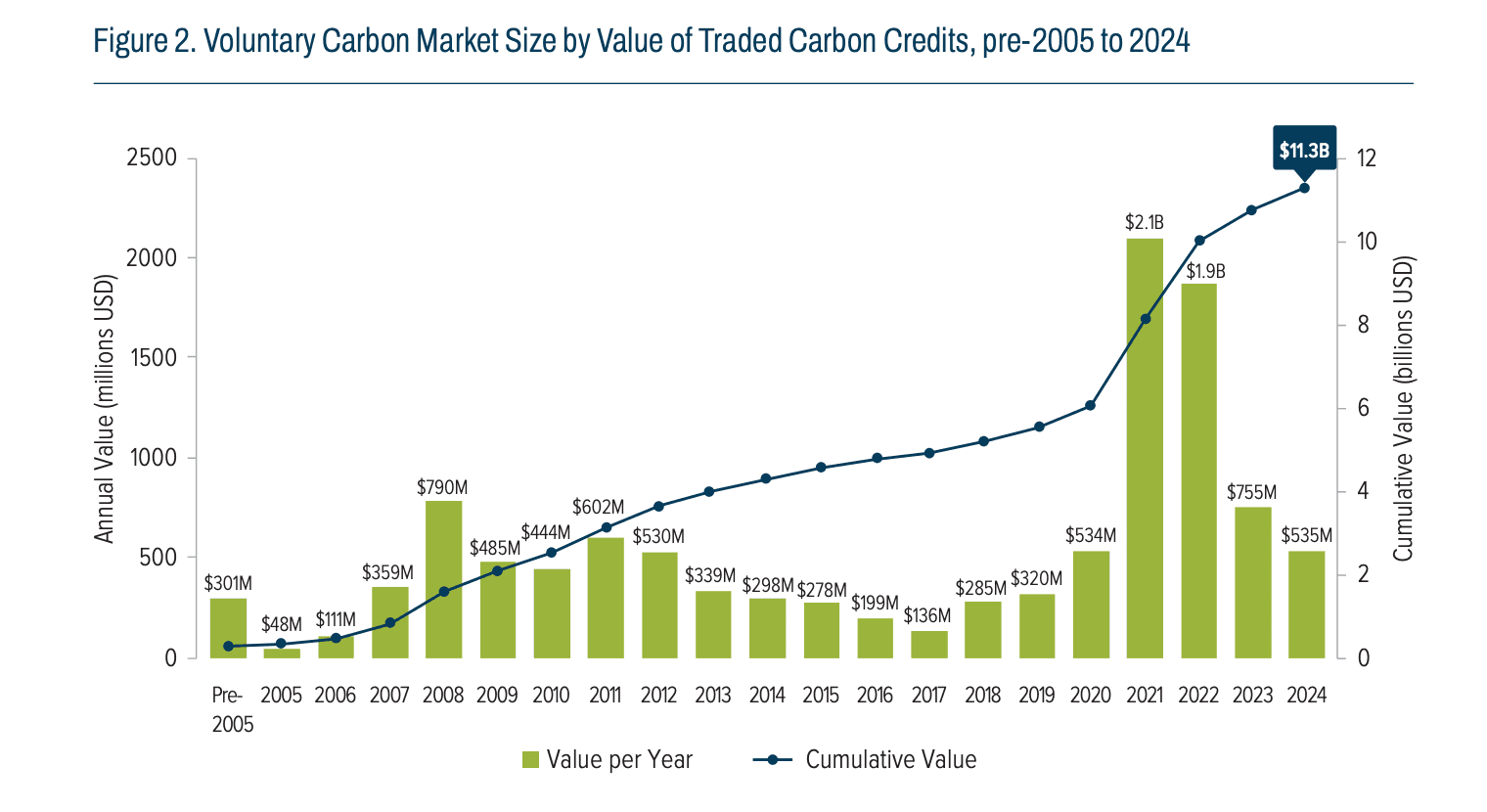
VCM transaction volumes hit their lowest point since 2018 in 2024. Source: Ecosystem Marketplace, State of the VCM 2025.
Research by Hughes et al. (2019) in Renewable and Sustainable Energy Reviews showed that distributed ledger systems can materially improve traceability in renewable energy certificates and carbon credit tracking, reducing double-counting risk and enhancing the auditability of lifecycle claims.
The argument is that tamper-proof issuance records and transparent lifecycle tracking reduce the information asymmetry that allowed the credibility crisis to develop in the first place.
For institutional investors, that verification layer is the difference between an instrument they can underwrite and one they cannot. Better infrastructure determines whether institutional capital enters the carbon market at all.
Food & Supply Chains: Waste as a Data Failure
Of the 1.05B tonnes of food wasted annually, a disproportionate share is lost in the supply chain before it reaches consumers, at the processing, storage, and logistics stages where provenance data is fragmented or absent.
Research by Saberi et al. (2019) in the International Journal of Production Research found that blockchain materially improves traceability and compliance in agricultural supply chains by enabling real-time data sharing across producers, distributors, and retailers.
The structured credit angle here is underappreciated.
Where inventory provenance is verifiable, agricultural receivables become easier to finance. A cargo of grain with a blockchain-attested origin, condition log, and custody trail is a stronger collateral basis than one without. Trade finance for agricultural supply chains, which is traditionally one of the more operationally complex areas of receivables financing, becomes lower-risk when the underlying data is machine-readable and auditable.
The logic is identical to what's driving tokenisation in CLOs and repo: reduce information friction, and capital flows more efficiently to where it's needed.
The Limits of Infrastructure
None of this is an argument that digital infrastructure solves these problems completely.
Political constraints, physical geography, and institutional inertia are not neutralised by a distributed ledger. Carbon markets can still be manipulated; water rights can still be captured by incumbents; food waste can persist regardless of data transparency if supply chain economics don't change.
There are also legitimate concerns about blockchain's own resource footprint. Bitcoin's proof-of-work consensus remains energy-intensive, and in 2024, Lawrence Berkeley National Laboratory reported that US data centres consumed 17.4B gallons of water in 2023 for cooling alone.
The shift to proof-of-stake and hybrid architectures reduces these costs significantly, but the industry's environmental overhead is not trivial and warrants continued scrutiny.
The Capital Markets Implication
The more interesting question is structural.
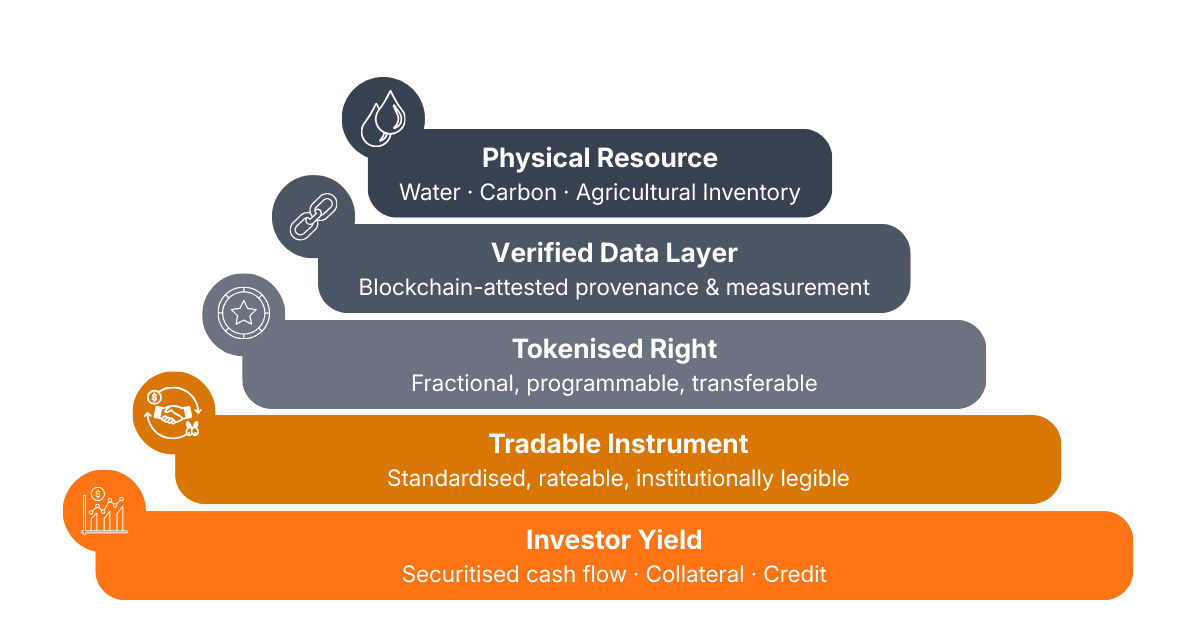
As water rights, verified carbon credits, and agricultural inventories become programmable and verifiable, they transition from opaque bilateral instruments into assets with a standardised data layer, the precondition for securitisation, structured finance, and institutional participation.
The institutions building on-chain infrastructure for bonds, funds, and repo are constructing the same rails that would, in principle, underwrite tokenised water concessions, carbon receivables, or agricultural inventory facilities.
The underlying mechanics are identical: measure the asset, verify the claim, programme the cash flow, reduce the friction.
If that logic holds as the evidence suggests, the next phase of tokenisation is not purely about digitising financial instruments. It is about whether digital infrastructure can improve how capital interacts with the physical world.
Who underwrites the first rated tranche of tokenised water infrastructure?
Who structures the first carbon receivables securitisation with auditable offset data as the credit enhancement?
Those questions are closer than most of the bond market currently appreciates.