Welcome to this week’s Tranched newsletter.
The original pitch for blockchain was trustless transactions between humans.
Fifteen years later, the fastest-growing use cases involve AI agents paying each other in fractions of a cent, sovereign land registries recording title deeds on public ledgers, and decentralised organisations funding clinical drug trials that traditional institutions will not touch. This week we examine what connects these three developments, why the technology is finding its product-market fit in places nobody expected, and what the architectural pattern means for structured finance.
In February 2026, a robot dog named Bits paid for its own electricity.
It walked to a charging station in a lab in San Francisco, negotiated a price in USDC, and settled the transaction on-chain. No human was involved. The payment was worth fractions of a cent.
The same month, the Dubai Land Department opened a secondary market for 7.8M tokens representing fractional ownership of ten residential properties. The tokens are backed by government-issued title deeds, recorded on a public blockchain, and available to investors starting at AED 2,000 (roughly $540).
And in a university lab somewhere between Boston and Berlin, a longevity researcher submitted a funding proposal to a decentralised autonomous organisation (DAO). The DAO's 9,000+ members voted on-chain. The grant was approved and disbursed in under 30 days. The traditional timeline for an equivalent NIH grant: 12 months, with a 19% success rate.
Three stories. Three entirely different domains. The same underlying infrastructure.
Blockchain spent a decade trying to convince humans to use it. The most interesting developments of 2026 suggest it may have found better customers.
The Machines
The original promise of blockchain was trustless coordination between parties that cannot verify each other. For most of its history, those parties were assumed to be people. Increasingly, they are software.
Ant Digital Technologies, the blockchain arm of Chinese conglomerate Ant Group, launched Anvita in April 2026 at its Real Up summit in Cannes. The platform enables AI agents to hold assets, execute trades, and settle payments in real time using stablecoins. Zhuoqun Bian, president of blockchain business at Ant Digital, framed the shift directly: the real transformation, he said, lies in moving toward an on-chain agentic economy where autonomous agents hold assets, execute trades, and optimise portfolios.
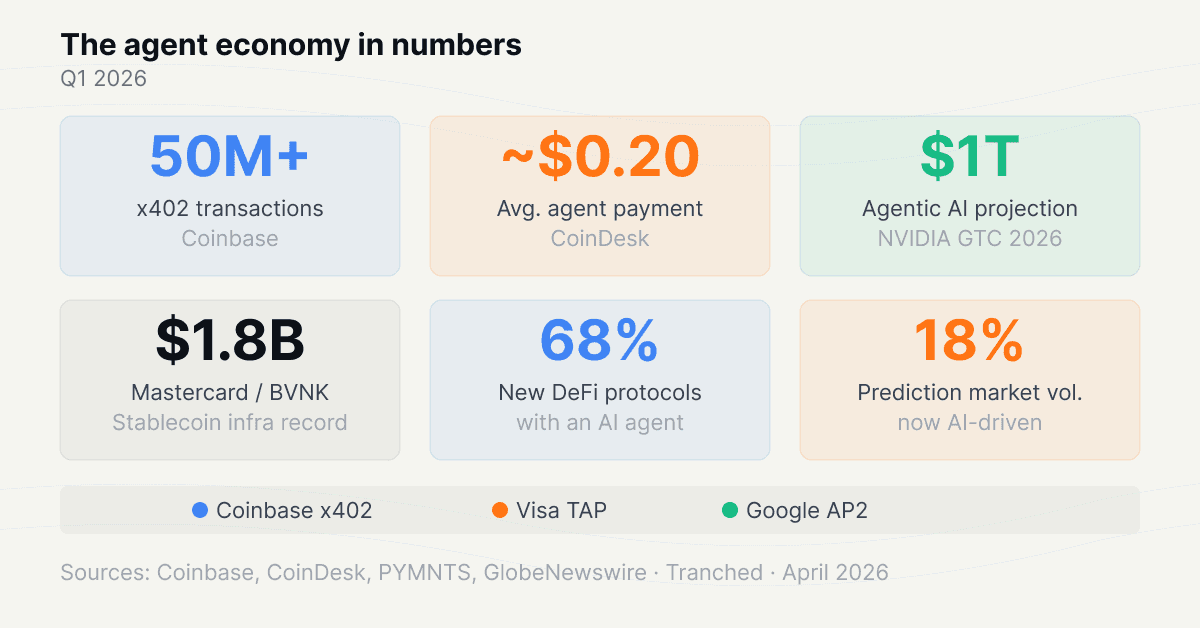
Ant is not alone. Coinbase's x402 protocol, which embeds stablecoin micropayments into standard HTTP requests, has processed over 50M transactions since launch. Partners include Stripe and Cloudflare. The average payment is around $0.20. Visa launched a competing Trusted Agent Protocol targeting card-rail checkout for autonomous agents. Google unveiled its Agent Payments Protocol (AP2) backed by over 60 organisations. Mastercard acquired stablecoin firm BVNK for $1.8B, the largest stablecoin infrastructure deal on record.
The numbers are still early. CoinDesk reported in March that x402's daily volume sits at roughly $28,000, with much of the spike activity attributed to infrastructure testing rather than genuine commerce. But the directional signal is clear.
NVIDIA CEO Jensen Huang projected a $1T agentic AI opportunity at GTC 2026. Illia Polosukhin, co-founder of NEAR Protocol, put it plainly in an interview with CoinDesk: the users of blockchain will be AI agents. AI is going to be on the front end, and blockchain is going to be on the back end.
The protocol wars have already started. Visa, Coinbase, and Google are each building competing standards for how machines will pay each other. The settlement layer they are all converging on is stablecoin-denominated, blockchain-native, and designed for sub-cent transactions at scale. 68% of new DeFi protocols launched in Q1 2026 included at least one autonomous AI agent. 18% of prediction market volume is now AI-driven.
Traditional payment rails were built for humans filling out forms. The internet's next payment layer is being built for software that has never seen a form.
The Buildings
While the agent economy is still finding its footing in transaction volume, sovereign governments are already recording property rights on public blockchains.
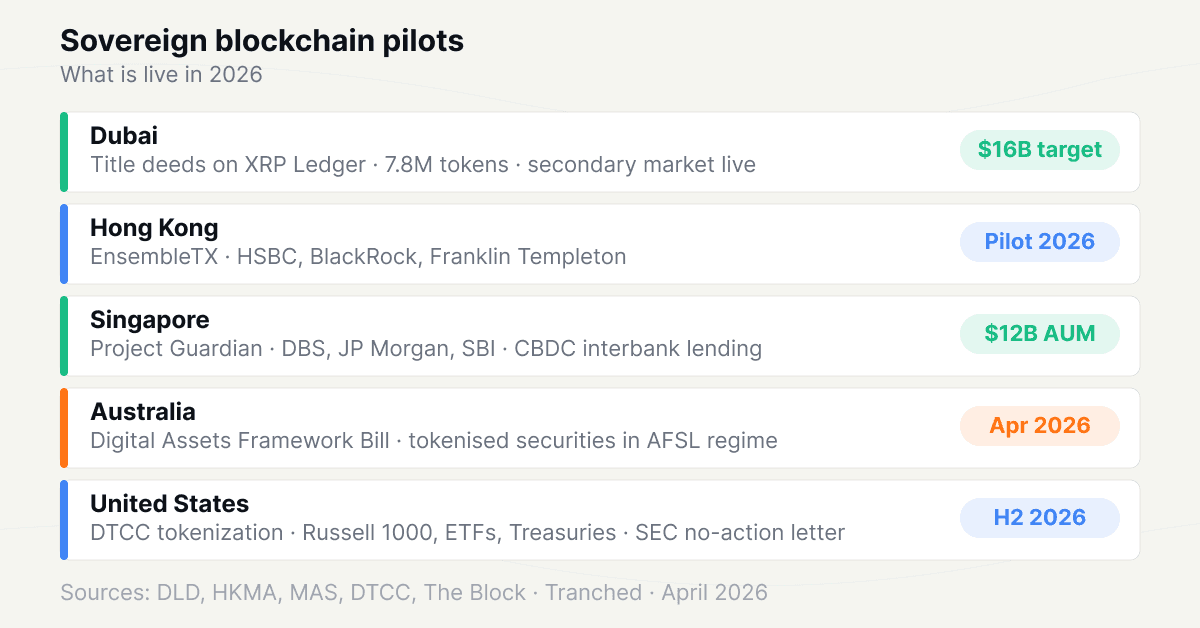
The Dubai Land Department (DLD) launched Phase 2 of its Real Estate Tokenisation Project in February 2026. In partnership with Ctrl Alt and the Virtual Assets Regulatory Authority (VARA), the DLD tokenised actual title deeds on the XRP Ledger, integrated directly with the government's property registry, and opened a secondary market for 7.8M tokens representing fractional ownership of ten Dubai properties. Ripple provides institutional-grade custody for the tokenised deeds. The entry point for investors: AED 2,000 (roughly $540). The DLD's stated target: $16B in tokenised property by 2033, equivalent to 7% of the city's total real estate market.
This is the first time a government real estate registration authority in the Middle East has placed title deeds on a public blockchain. The tokens are paired with Asset-Referenced Virtual Assets (ARVAs) that regulate who can trade and under what conditions. Every trade is reflected in Dubai's official property registry.
🇦🇪Dubai is not operating in isolation. Hong Kong's Monetary Authority launched EnsembleTX, a pilot programme running throughout 2026 that enables financial institutions to use tokenised deposits for money market fund transactions and treasury management. Participants include Standard Chartered, HSBC, Bank of China (Hong Kong), BlackRock, and Franklin Templeton. Settlement occurs through the HKD Real Time Gross Settlement system.
🇸🇬Singapore's Project Guardian, run by the Monetary Authority of Singapore, has moved beyond pilots into a live ecosystem connecting institutions including DBS, JP Morgan, and SBI Group. Assets under management reached $12B in Q1 2026. Three Singaporean banks (DBS, OCBC, UOB) conducted interbank overnight lending using a wholesale Singapore dollar central bank digital currency.
🇦🇺Australia passed the Corporations Amendment (Digital Assets Framework) Bill on April 1, 2026, integrating tokenised assets into the existing Australian Financial Services Licence regime. It makes Australia one of the first common-law jurisdictions to give tokenised securities full legal standing within corporate law.
The pattern across all five jurisdictions is the same: existing legal frameworks are being extended to accommodate on-chain assets, rather than new frameworks being built from scratch. The blockchain recedes. The property right, the deposit, the licence remains.
The Labs
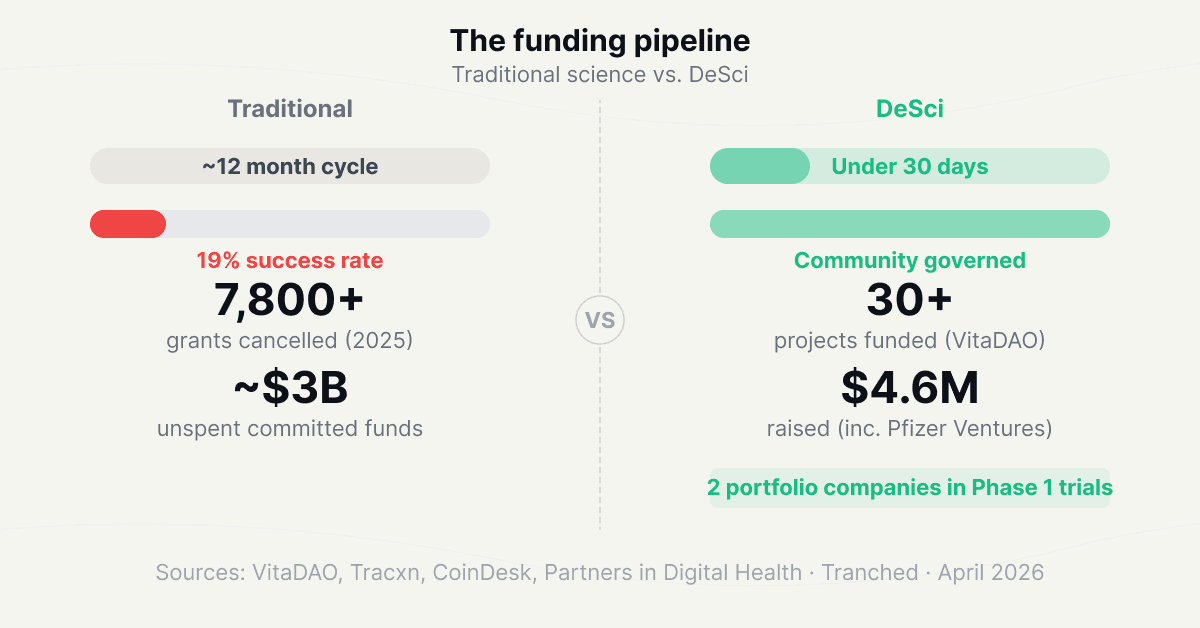
Science is expensive, slow, and gatekept. The funding pipeline for biomedical research in the United States has faced significant disruption, with 7,800+ NIH and NSF grants cancelled or suspended during 2025, representing roughly $3B in unspent committed funds.
A parallel infrastructure is emerging. Decentralised Science, or DeSci, applies blockchain governance, tokenised incentives, and DAO-based coordination to scientific research. The premise is straightforward: if centralised funding bodies create bottlenecks, decentralised alternatives can route around them.
VitaDAO, founded in 2021, is the most established example. The community-owned collective has funded 30+ longevity research projects, raised $4.6M in total funding from investors including Pfizer Ventures and Ethereum co-founder Vitalik Buterin, and has slashed funding timelines from 12 months to under 30 days using IP-NFTs (tokens representing intellectual property rights in drug development). One of its portfolio companies, Cyclarity Therapeutics, has a Phase 1 clinical trial ongoing with readout expected later in 2026. Another, Rubedo Life Sciences, announced positive Phase 1 results in March for a first-in-class senescent cell therapy.
VitaDAO is one of roughly 50 active DeSci initiatives operating as of early 2026. AthenaDAO funds women's health research. HairDAO funds projects addressing hair loss. Bio Protocol provides modular infrastructure for launching specialised BioDAOs. Molecule Protocol enables the tokenisation of drug development rights through IP-NFTs.
The model is simple.
A researcher submits a proposal → The community reviews and votes on-chain → Capital is deployed → Intellectual property rights are encoded in smart contracts → Every decision, every disbursement, every vote is recorded on a public ledger.
The governance model is the feature. Transparent allocation, community-driven priorities, on-chain accountability. The blockchain is invisible to the end user. The science is not.
The Thread
A robot dog paying for electricity, a Dubai apartment split into 7.8M pieces, and a longevity drug funded by strangers on the internet do not, at first glance, share much in common.
But the infrastructure underneath each of them is the same:
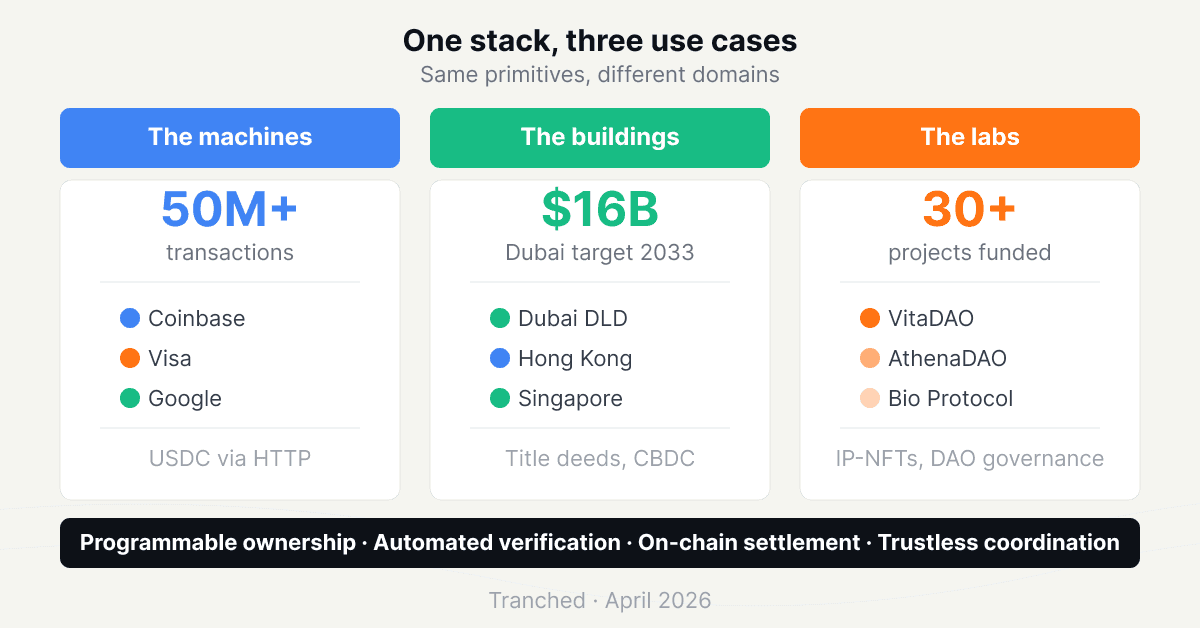
Programmable ownership
Automated verification
Trustless coordination between parties that have no prior relationship.
In the agent economy, the parties are software processes that need to pay each other without human approval. In property markets, the parties are fractional owners who need their rights recorded by a neutral, auditable system. In science, the parties are researchers and funders who need transparent governance without institutional gatekeepers.
Each use case solves a different problem. Each one relies on the same architectural primitives: on-chain settlement, smart contract logic, tokenised rights, and immutable records.
The blockchain is the plumbing, and like all good plumbing, it works best when nobody notices it is there.
What This Means
The architectural pattern repeating across agents, property, and science points to something broader than any single use case. Programmable verification, trustless coordination, and transparent governance are becoming baseline expectations across industries that have historically relied on intermediaries, manual processes, and institutional trust. The technology is proving its value precisely where the legacy infrastructure is weakest: in environments where multiple parties need to agree on a shared state without relying on a single authority to maintain it.
Structured credit is one of those environments. Every securitisation and private credit transaction depends on waterfall distributions, eligibility testing, and borrowing base certifications that are still, in many cases, run on spreadsheets by parties with commercial conflicts of interest. The same principles that allow a DAO to fund a clinical trial transparently, or a land registry to record fractional ownership on a public ledger, apply directly to how a calculation agent certifies cash flows.
Tranched is building at this intersection. Verifiable methodology, structural independence between the certifying party and the transaction parties, every input logged, every output tied to a specific version and date. The infrastructure pattern is already working in property, science, and machine commerce. The question for structured credit is whether it adopts the same standard, or continues to rely on the infrastructure it has always used.